On June 1, 2026, Vietnam’s Ministry of Industry and Trade and Ministry of Information and Communications jointly issued Circular No.18/2026/TT-BCT-BTTTT, introducing new import requirements for digital signage equipment and related software. The update deserves close attention from digital signage importers, software suppliers, distribution channels, compliance teams, and buyers serving the Vietnamese market because customs clearance and subsequent VTV certification access are now directly linked to information security certification and Vietnamese-language content filing.
Event Overview
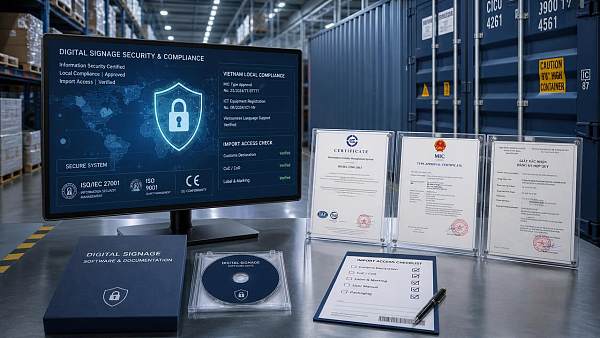
According to the information currently available, Circular No.18/2026/TT-BCT-BTTTT took effect on June 1, 2026. From that date, all imported digital signage equipment and supporting software must be submitted together with an ISO/IEC 27001 information security management system certificate and proof of Vietnamese-language localized content filing.
The publicly stated requirement is mandatory for both the equipment and the supporting software involved in digital signage imports. Products that do not meet these submission requirements will be refused by customs and will not be allowed to enter the VTV certification process.
Which Segments Are Affected
Digital Signage Importers and Direct Trade Companies
Importers are the most directly affected because the new rule connects customs acceptance with two specific documents: ISO/IEC 27001 certification and Vietnamese-language localized content filing proof. If either document is missing, the shipment may not proceed through customs based on the stated requirement.
From an industry perspective, the main impact is likely to appear in pre-shipment document review, supplier qualification checks, and import schedule planning. Importers serving Vietnam will need to confirm whether equipment and related software packages can be supported by the required compliance materials before arranging shipment.
Digital Signage Hardware Manufacturers and Export Suppliers
Manufacturers and export suppliers that provide digital signage equipment to Vietnam may face additional documentation expectations from their import partners. Although the circular concerns imports into Vietnam, suppliers that cannot provide the required certification materials or coordinate software-related filing information may become less suitable for Vietnam-bound orders.
Analysis shows that the requirement may shift part of the compliance workload upstream. Hardware suppliers may need to clarify whether the products, software components, and accompanying documentation can be aligned before goods are exported.
Software Providers and Content Localization Teams
The rule explicitly includes supporting software and Vietnamese-language localized content filing proof. This makes software configuration, content localization, and filing documentation more relevant to the import process than in a purely hardware-focused shipment.
What is more worth noting at present is that the requirement does not only point to technical equipment. It also links market entry to localized content documentation. Software providers and localization teams involved in digital signage projects for Vietnam should therefore pay attention to whether their deliverables can support the required filing proof.
Channel Distributors and Project Integrators
Distributors and project integrators may be affected because delays at the import stage can influence project delivery timelines, customer commitments, and inventory planning. If imported devices or related software cannot clear customs or enter VTV certification, downstream deployment may also be delayed.
Observably, the impact for channel businesses is not limited to regulatory paperwork. It may also appear in order confirmation, customer communication, stock availability, and the timing of project installation in Vietnam.
Compliance, Certification, and Supply Chain Service Providers
Companies involved in customs documentation, certification coordination, and supply chain support may see increased demand for more precise document verification related to digital signage imports. The new requirement gives these service roles a clearer connection to import readiness.
It is more appropriate to understand this as a higher threshold for documentation consistency rather than a simple customs formality. Service providers may need to check whether ISO/IEC 27001 certification and localized content filing proof are available before supporting shipment or certification workflows.
Key Issues to Watch and Practical Responses
Track Official Clarifications and Implementation Details
Companies involved in Vietnam-bound digital signage business should continue monitoring official statements from the relevant authorities. The current information confirms the effective date, document requirements, customs refusal consequence, and VTV certification restriction, but implementation details may require continued attention.
Analysis shows that companies should avoid relying only on internal assumptions. A practical response is to maintain a checklist based on the circular and update it when additional official guidance becomes available.
Review Product Scope Before Shipment
Enterprises should identify which products fall under imported digital signage equipment and which software items are considered supporting software. This review should be completed before purchase orders, shipment booking, or customs declaration preparation.
From an industry perspective, the key operational risk is mismatch between the physical product, software package, and required documents. Companies should confirm document availability at the quotation or contract stage rather than after goods arrive at customs.
Separate Policy Signal from Business Execution
The circular sets mandatory requirements, but each company’s actual exposure depends on whether it imports digital signage equipment and related software into Vietnam. Businesses should distinguish between the policy signal and their own product flow, market scope, and order pipeline.
What is more worth noting at present is that companies with Vietnam-related digital signage orders should treat the rule as an execution issue, not only a compliance notice. This means aligning sales, procurement, logistics, and documentation teams around the same import requirements.
Prepare Supplier Communication and Contingency Plans
Importers, distributors, and integrators should communicate with suppliers early to confirm whether ISO/IEC 27001 certification documents and Vietnamese-language localized content filing proof can be provided. If documentation cannot be confirmed, companies may need to reassess shipment timing or supplier suitability.
Observably, the most practical preparation is to build a pre-import document review process for Vietnam-bound digital signage projects. This can help reduce the risk of customs refusal and prevent products from being blocked before the VTV certification stage.
Editor’s View / Industry Observation
Analysis shows that this update makes information security management and localized content documentation part of the entry threshold for imported digital signage products in Vietnam. It is not merely a technical certification issue, because the rule also affects customs acceptance and access to the VTV certification process.
It is more appropriate to understand this as a concrete regulatory result that has already taken effect, while some operational details may still require continued observation. For companies active in digital signage equipment, software, import distribution, or project integration, the central issue is whether compliance materials can be prepared before goods enter the import process.
From an industry perspective, the rule also signals that digital signage imports are being assessed through both information security and localized content requirements. Businesses connected to the Vietnamese market should therefore treat documentation readiness as part of market access planning.
Conclusion
The implementation of Circular No.18/2026/TT-BCT-BTTTT marks a clear change for Vietnam-bound digital signage imports. The industry significance lies in the linkage between customs clearance, ISO/IEC 27001 certification, Vietnamese-language localized content filing, and VTV certification access.
A rational and neutral conclusion is that companies should not view this update as a general industry trend without action, nor as a one-time news item. It is more appropriate to understand it as an effective import compliance requirement that calls for immediate document review, supplier coordination, and continued monitoring of official implementation details.
Information Source Statement
Main sources: Vietnam Ministry of Industry and Trade; Vietnam Ministry of Information and Communications; Circular No.18/2026/TT-BCT-BTTTT.
Items requiring continued observation: further official explanations, implementation procedures, and practical document review requirements related to customs acceptance and VTV certification access for imported digital signage equipment and supporting software.