[FIN]CROSS-BORDERVOL: $4.2T
[SEC]CYBER ALERT: TIER2
[POL]IS0 GROWTH:+14%
[GEO] CLOUDINDEX: +2.4%
Structural Logic
Category Filters
RCEP Digital Signage Mutual Recognition Extended to Vietnam
Lead Author
Published
Views:
On May 10, 2026, Vietnam officially joined the RCEP Framework’s Digital Signage Products Conformity Assessment Mutual Recognition Arrangement (D-Signage MRAs). This development significantly accelerates customs clearance for certified digital signage products traded between China and Vietnam—cutting average processing time from seven days to under 48 hours. The move directly impacts manufacturers, exporters, component suppliers, and logistics service providers across the digital display supply chain in Asia-Pacific.
Event Overview
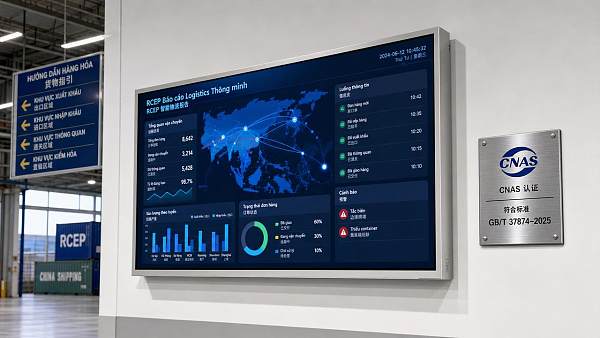
According to an official notification issued by the RCEP Secretariat on May 7, 2026, Vietnam has formally acceded to the D-Signage MRAs mechanism. Effective May 10, 2026, conformity assessment reports issued by laboratories accredited by China’s National Accreditation Service for Conformity Assessment (CNAS) and based on the national standard GB/T 37874–2025 are now accepted directly by Vietnamese customs authorities. This eliminates redundant testing, certification duplication, and administrative delays at the border.
Industries Affected
Direct Trading Enterprises: Exporters and importers of digital signage hardware—including LED video walls, interactive kiosks, and smart retail displays—are now exempt from re-certification in Vietnam. Their primary impact is reduced compliance overhead, faster cash conversion cycles, and improved responsiveness to seasonal demand spikes (e.g., retail promotions or public infrastructure rollouts).
Raw Material Procurement Enterprises: Firms sourcing optical films, driver ICs, PCB substrates, or aluminum extrusions for signage assembly benefit indirectly: shorter lead times enable tighter inventory planning and reduce safety stock requirements. However, they remain unaffected by MRAs unless they also act as branded exporters—meaning their exposure is operational rather than regulatory.
Manufacturing Enterprises: OEM/ODM producers in Guangdong, Jiangsu, and Zhejiang provinces face lower post-production friction when shipping finished units to Vietnam. Crucially, this does not relax domestic Chinese production standards; instead, it validates existing CNAS-recognized test reports as sufficient for market access—reinforcing quality discipline while lowering time-to-revenue.
Supply Chain Service Providers: Customs brokers, freight forwarders, and third-party conformity assessment consultants must update internal workflows and client advisories. For instance, documentation packages no longer require Vietnamese-accredited lab reports—only validated CNAS seals and GB/T 37874–2025 reference numbers. This simplifies service delivery but compresses margins for firms previously charging premium fees for parallel certification support.
Key Considerations and Recommended Actions
Verify Lab Accreditation Status Before Shipment
Not all CNAS-accredited labs are authorized to issue GB/T 37874–2025 reports. Exporters must confirm that their chosen laboratory holds active scope accreditation specifically for Clause 6 (electromagnetic compatibility), Clause 7 (safety), and Clause 8 (environmental adaptability) of the standard—per CNAS’s latest published schedule.
Update Labeling and Technical Documentation
Vietnamese customs now cross-check physical product labels against the declared conformity report. Enterprises must ensure bilingual (English–Vietnamese) labeling includes traceable model numbers, batch IDs, and explicit reference to GB/T 37874–2025—not just “RCEP-compliant” or “MRAs-accepted.”
Monitor Implementation Consistency Across Ports
While the policy is nationally effective, early field reports indicate variability in enforcement between Ho Chi Minh City’s Cat Lai Port and Hai Phong’s Lach Huyen Terminal. Traders are advised to pilot shipments through both gateways and document clearance timelines for internal benchmarking.
Editorial Perspective / Industry Observation
Analysis shows that this expansion is less about tariff reduction—and more about regulatory harmonization as a de facto trade enabler. Unlike earlier RCEP provisions focused on duty cuts, the D-Signage MRAs targets non-tariff barriers rooted in technical sovereignty. Observably, Vietnam’s accession signals growing confidence in regional testing infrastructure—and willingness to cede some national conformity autonomy in exchange for speed and predictability. From an industry perspective, this sets a precedent likely to be extended to adjacent categories (e.g., commercial audio systems or IoT-enabled lighting controls) within the next 12–18 months—but only if data on dispute resolution and audit transparency proves robust.
Conclusion
This milestone reflects a maturing phase of RCEP implementation: one where interoperability of technical regulations—not just preferential tariffs—becomes the central lever for supply chain efficiency. It does not eliminate risk, but reshapes its distribution: compliance risk shifts upstream (to lab selection and documentation rigor), while logistical uncertainty recedes downstream. For the digital signage sector, it is better understood as an operational upgrade than a strategic pivot.
Source Attribution
Primary source: RCEP Secretariat Notification No. RCEP-MRA/DS/2026/05, issued May 7, 2026. Verified against CNAS Announcement CNAS-SC037:2026 (Revision 2), effective April 15, 2026. Ongoing monitoring recommended for: (1) Vietnam Ministry of Science and Technology’s forthcoming Circular on MRA Enforcement Protocols; (2) Updates to GB/T 37874 revision cycle beyond 2025; (3) Potential inclusion of Cambodia and Laos in Phase II of D-Signage MRAs, anticipated Q4 2026.
Tags
Recommended for You
 Aquaculture & Fishery Equipment Upgrades: What Improves Yield MostAquaculture & Fishery equipment upgrades that boost yield most: improve aeration, water quality monitoring, and feeding precision first to cut losses, raise growth, and invest smarter.May 12, 2026Lina Cloud
 Active Pharmaceutical Ingredients OEM: Common Compliance Gaps to CheckActive pharmaceutical ingredients OEM compliance gaps can delay approvals and disrupt supply. Discover the key risks, audit checkpoints, and practical actions to protect quality and business continuity.May 12, 2026Marcus Trust
 Chiral Intermediates Wholesale: Price Risks and Supply StabilityChiral intermediates wholesale insights for finance approvers: assess price volatility, supply stability, and hidden sourcing risks to protect budgets, margins, and continuity.May 12, 2026Lina Cloud
 Peptide Synthesis Services: How to Judge Quality and Lead TimePeptide synthesis services explained: learn how to judge quality, purity, documentation, and realistic lead times so you can compare suppliers with confidence and avoid costly delays.May 12, 2026Marcus Trust
 Feed & Grain Processing Technology Trends Shaping Plant UpgradesFeed & Grain processing technology trends are reshaping plant upgrades with smarter automation, energy savings, traceability, and lower downtime. Discover how to plan future-ready investments.May 12, 2026Lina Cloud
 Feed & Grain Processing Equipment: Key Safety Checks Before InstallationFeed & Grain processing equipment safety starts before installation. Learn key checks for dust control, guarding, electrical integrity, and compliance to reduce risk and ensure reliable startup.May 12, 2026Marcus Trust
 Agri & Forestry Machinery Manufacturers: Cost vs Service Trade-OffsAgri & Forestry machinery manufacturers are best judged beyond price alone. Learn how service, uptime, parts support, and compliance shape total ownership value and smarter buying decisions.May 12, 2026Lina Cloud
 Top Agri & Forestry Machinery Manufacturers for Reliable OutputAgri & Forestry machinery manufacturers compared for reliability, uptime, lifecycle value, and service support. Discover top brands and choose the right partner for resilient output.May 12, 2026Lina Cloud
 How to Compare Agri & Forestry Machinery Specifications Before PurchaseAgri & Forestry machinery specifications explained through real farming, orchard, forestry, and fleet scenarios—compare power, hydraulics, safety, and service to buy with confidence.May 12, 2026Lina Cloud
 Agri & Forestry Machinery Specifications That Matter Most in 2026Agri & Forestry machinery specifications guide for 2026: compare powertrain, hydraulics, digital systems, compliance, and serviceability to cut downtime and buy smarter.May 12, 2026Lina Cloud
 Chinese Shipyards Secure 13+6 Vessels Amid Smart Hardware Export SurgeChinese shipyards secure 13+6 vessels amid smart hardware export surge — driving demand for certified marine POS terminals, PDAs & intelligent terminal systems.May 12, 2026Dr. Marcus Fin
 2026 Taihu Bay Life Health Future Conference Opens2026 Taihu Bay Life Health Future Conference launches AI medical device export acceleration for Germany, Saudi Arabia & Vietnam—act now.May 12, 2026Professor Sarah Ed
 IEC 62443-4-2:2026 Released: AI Threat Modeling Mandatory for Industrial PDAsIEC 62443-4-2:2026 mandates AI threat modeling for industrial PDAs—key for EU/US critical infrastructure access. Act now to secure certification before Nov 1, 2026.May 12, 2026Digital Signage
 UAE ADHOC AI Learning Terminal Whitelist 2.0 Adds 12 Arabic STEM ResourcesUAE ADHOC AI Learning Terminal Whitelist 2.0 adds 12 Arabic STEM resources — essential for edtech exporters targeting UAE public schools. Act now to ensure compliance & market access.May 12, 2026Professor Sarah Ed
 Germany's TÜV Updates EMVCo 5.4 Certification: AI Fraud Detection Mandatory for POS TerminalsEMVCo 5.4 certification now mandates AI fraud detection for POS terminals in Germany, Austria & Switzerland—learn how TÜV Rheinland’s update impacts compliance, procurement, and AI governance.May 12, 2026Dr. Marcus Fin
 Saudi SASO Launches ICT-2026 AI Review System for ICT ProductsSASO ICT-2026 AI Review System launched: Arabic UI localization & 15-day CoC certification for POS, kiosks & digital signage — act now!May 12, 2026Dr. Marcus Fin
 ADHOC Releases AI Learning Terminal Content Whitelist 2.0ADHOC AI Learning Terminal Content Whitelist 2.0 launches in UAE—streamlining 24-hour market access for Arabic STEM edtech hardware, content & integrators.May 11, 2026Professor Sarah Ed
 Germany TÜV Updates EMVCo 5.4 Certification: AI Risk Module Required for POS TerminalsEMVCo 5.4 certification now requires AI Risk Module for POS terminals—TÜV Germany mandates PCI AI-Risk Engine v1.0 compliance by Sep 2026. Act now!May 11, 2026Dr. Marcus Fin
 SASO Launches ICT-2026 AI Review System for UI LocalizationSASO's ICT-2026 AI Review System accelerates Arabic UI localization for interactive flat panels, AI learning terminals & digital signage — cut certification from 62 to 15 days.May 11, 2026Professor Sarah Ed
 Vietnam Enforces VNPAY QR v3.2 SDK Pre-installation for Digital Signage ImportsVNPAY QR v3.2 SDK pre-installation is now mandatory for digital signage, kiosks & POS hardware imported into Vietnam from 1 June 2026—avoid payment refusal and delays.May 11, 2026Digital Signage
 IEC 62443-4-2:2026 Released: AI Threat Modeling Mandatory for Industrial PDA ExportsIEC 62443-4-2:2026 mandates AI threat modeling for industrial PDAs—key for EU, Middle East & RCEP exports. Act now to align development, certification & firmware baselining.May 11, 2026Digital Signage
![]() Germany's TÜV Updates EMVCo 5.4 Certification: AI Risk Controls Mandatory for POS TerminalsEMVCo 5.4 certification now mandates AI risk controls for POS terminals in Europe—learn how TÜV Rheinland’s May 2026 update impacts compliance, hardware design & SCA readiness.May 10, 2026Dr. Marcus Fin
Germany's TÜV Updates EMVCo 5.4 Certification: AI Risk Controls Mandatory for POS TerminalsEMVCo 5.4 certification now mandates AI risk controls for POS terminals in Europe—learn how TÜV Rheinland’s May 2026 update impacts compliance, hardware design & SCA readiness.May 10, 2026Dr. Marcus Fin![]() ADHOC Releases AI Learning Hubs Content Whitelist 2.0 for UAE SchoolsADHOC AI Learning Hubs Content Whitelist 2.0 now mandates Arabic STEM resources for UAE schools — key for edtech vendors, hardware makers & integrators seeking compliance and tender access.May 10, 2026Professor Sarah Ed
ADHOC Releases AI Learning Hubs Content Whitelist 2.0 for UAE SchoolsADHOC AI Learning Hubs Content Whitelist 2.0 now mandates Arabic STEM resources for UAE schools — key for edtech vendors, hardware makers & integrators seeking compliance and tender access.May 10, 2026Professor Sarah Ed![]() Saudi SASO Launches ICT-2026 AI Review System for UI LocalizationSASO's ICT-2026 AI Review System streamlines UI localization certification for smart terminals in Saudi Arabia—faster, smarter, and mandatory for POS, kiosks & digital signage exporters.May 10, 2026Dr. Marcus Fin
Saudi SASO Launches ICT-2026 AI Review System for UI LocalizationSASO's ICT-2026 AI Review System streamlines UI localization certification for smart terminals in Saudi Arabia—faster, smarter, and mandatory for POS, kiosks & digital signage exporters.May 10, 2026Dr. Marcus Fin![]() China Customs Launches AI Fast-Check Channel for STEM KitsChina Customs AI Fast-Check Channel for STEM Kits slashes clearance to 72h — AEO exporters to UAE/Saudi gain speed, compliance & competitive edge.May 10, 2026Professor Sarah Ed
China Customs Launches AI Fast-Check Channel for STEM KitsChina Customs AI Fast-Check Channel for STEM Kits slashes clearance to 72h — AEO exporters to UAE/Saudi gain speed, compliance & competitive edge.May 10, 2026Professor Sarah Ed![]() IEC 62443-4-2:2026 Mandates AI-Driven Threat Modeling for Industrial PDAsIEC 62443-4-2:2026 mandates AI-driven threat modeling for industrial PDAs—learn how it impacts exports to Germany, US & Singapore and what to do now.May 10, 2026Digital Signage
IEC 62443-4-2:2026 Mandates AI-Driven Threat Modeling for Industrial PDAsIEC 62443-4-2:2026 mandates AI-driven threat modeling for industrial PDAs—learn how it impacts exports to Germany, US & Singapore and what to do now.May 10, 2026Digital Signage EU EN 62366-1:2026 Transition Period LaunchedEU EN 62366-1:2026 transition is live—act now! Ensure IFP compliance with clinical-grade usability validation & updated TCFs before 31 Dec 2026.May 10, 2026Professor Sarah Ed
 VNPAY QR v3.2 SDK Mandatory Upgrade from June 1, 2026VNPAY QR v3.2 SDK mandatory upgrade by June 1, 2026 — critical for Chinese POS, kiosk & digital signage exporters to avoid payment rejection and ensure Vietnam market access.May 10, 2026Dr. Marcus Fin
 Aquaculture & Fishery Equipment: What to Check FirstAquaculture & Fishery equipment: learn what to check first—site fit, compliance, durability, energy use, service support, and total cost—before you buy with confidence.May 09, 2026Lina Cloud
 Organic Solvents Wholesale: Price, Purity, and Supply RiskOrganic solvents wholesale decisions go beyond price. Learn how to compare purity, compliance, and supply risk to source smarter, reduce hidden costs, and secure reliable bulk solvent supply.May 09, 2026Marcus Trust
 Biochemical Reagents Manufacturer Compliance ChecklistBiochemical reagents manufacturer compliance checklist: compare certifications, traceability, quality controls, and supply risks to choose reliable suppliers with confidence.May 09, 2026Marcus Trust
 Bulk Laboratory Reagents: Storage and Handling RisksBulk laboratory reagents demand strict storage and handling control. Discover key risks, compliance tips, and practical ways to protect QC accuracy, safety, and costs.May 09, 2026Marcus Trust
 Feed & Grain Processing Technology Trends for 2026Feed & Grain processing technology trends for 2026: explore smart automation, traceability, energy optimization, and compliance insights to improve efficiency and de-risk investment decisions.May 09, 2026Lina Cloud
 Feed & Grain Processing Equipment: Cost vs OutputFeed & Grain processing equipment cost vs output: compare capex, efficiency, uptime, and ROI to choose smarter systems that protect margins and boost long-term production value.May 09, 2026Lina Cloud
 Top Risks When Evaluating Agri & Forestry SuppliersAgri & Forestry supplier risks go beyond price. Learn how to assess compliance, traceability, sustainability claims, delivery reliability, and digital readiness before costly mistakes.May 09, 2026Lina Cloud
 Agri & Forestry Machinery Manufacturers: Key Selection ChecksAgri & Forestry machinery manufacturers: learn the key checks for quality, compliance, service, and supply stability to reduce sourcing risk and choose reliable partners.May 09, 2026Lina Cloud
 Agri & Forestry Machinery Specifications That Affect UptimeAgri & Forestry machinery specifications that affect uptime: compare cooling, hydraulics, filtration, service access, and diagnostics to reduce downtime and choose more reliable equipment.May 09, 2026Lina Cloud
 How to Compare Agri & Forestry Machinery SpecificationsAgri & Forestry machinery specifications explained in a practical guide covering performance, compliance, telematics, safety, and lifecycle cost to help you compare smarter and choose with confidence.May 09, 2026Lina Cloud
 IEC Updates IEC 62443-4-2:2026 for Industrial PDAsIEC 62443-4-2:2026 mandates AI-driven threat modeling for Industrial PDAs—key for energy, logistics & manufacturing. Learn what it means for your 2027 tenders.May 09, 2026Digital Signage
![]() MIIT Launches 'Model-Data Resonance' Initiative for AI Terminal ExportsMIIT's 'Model-Data Resonance' initiative mandates AI terminal exporters to align UI & edge inference with Qwen-VL-Max, GLM-Zero—key for global compliance & faster market access.May 09, 2026Dr. Hideo Tanaka
MIIT Launches 'Model-Data Resonance' Initiative for AI Terminal ExportsMIIT's 'Model-Data Resonance' initiative mandates AI terminal exporters to align UI & edge inference with Qwen-VL-Max, GLM-Zero—key for global compliance & faster market access.May 09, 2026Dr. Hideo Tanaka